The Sponor Architecture
A model that remembers by resonating, not by storing.
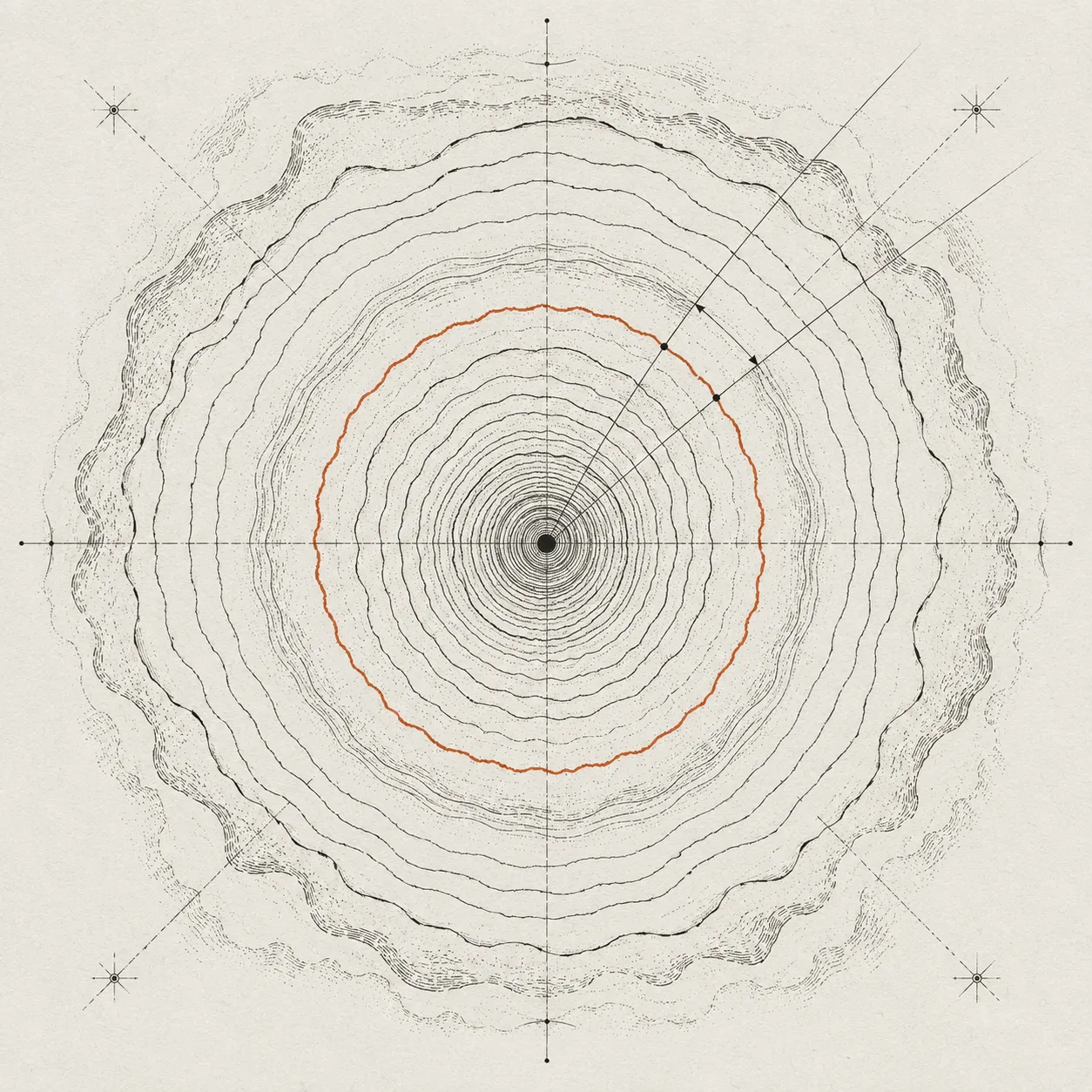
Every long-context transformer pays the same bill: a KV cache that grows with everything it has ever seen. Sponor's central bet is that this is not a necessary cost of memory — it's a consequence of one specific way of implementing memory. We are building the other way.
 loading=eager
fetchpriority=auto
/>
loading=eager
fetchpriority=auto
/>
The components
Six pieces that do the core work, in the order signal moves through them.
- 01
PSSR — Persistent Spectral State Resonance
The resonance field itself — the mechanism that replaces attention and the KV cache. State persists as phase, not as stored tokens.
- 02
FEAC — Unified Free-Energy Gate
A single gating principle governing what the field retains, rather than a separate mechanism per layer.
- 03
LSH-DCT + PCM — Sparse Local Attention + Phase Coherence
Where local, token-to-token precision still matters, applied sparsely and reconciled against the field by phase.
- 04
HRS — Zero-Attention Long Context
How long-range dependency is carried without any attention operation at all, at any range.
- 05
V-ROP — Output Projection
Reads the field back out into token-space predictions.
- 06
Sparse MoE FFN — Mixture-of-Experts Feed-Forward
Capacity scaling that stays sub-linear in active compute.
Supporting mechanisms
The Effective Context Bound
Long-context claims in the literature are almost always empirical: train the model, run a retrieval test, report the number that came out. The Effective Context Bound (ECB) is our attempt to derive that number instead of measuring it after the fact.
If context is carried by a resonance field, the field has a spectrum, and the spectral gap between its lowest modes sets an analytic bound on how far a signal can propagate before it is indistinguishable from noise. That bound is computable from the field's own parameters, before a single training step runs.
Whether a tight analytic bound is a useful one is a separate, open question — an elegant bound on a weak field doesn't help anyone. Read the current thinking on this in The Lab .
Roadmap — eleven phases
We are in Phase 1. This list will move slowly, on purpose, and we'll update it here rather than promise a date we don't know.
- 00 Theory Done
- 01 PSSR standalone implementation In progress
- 02 FEAC gating integration Not started
- 03 Sparse local attention layer Not started
- 04 Long-context (HRS) validation Not started
- 05 Output projection + decoding Not started
- 06 MoE FFN integration Not started
- 07 Small-scale end-to-end training Not started
- 08 ECB empirical validation Not started
- 09 Scaling study Not started
- 10 Publication Not started
What we don't know yet
This could fail at any of several points: the field could prove numerically unstable at scale, the ECB could turn out to bound something that doesn't matter in practice, or a sparse local attention layer we still need for precision could reintroduce the costs we're trying to remove. We would rather list these plainly than round them off in the framing.
Follow the actual progress, including the dead ends, in The Lab.